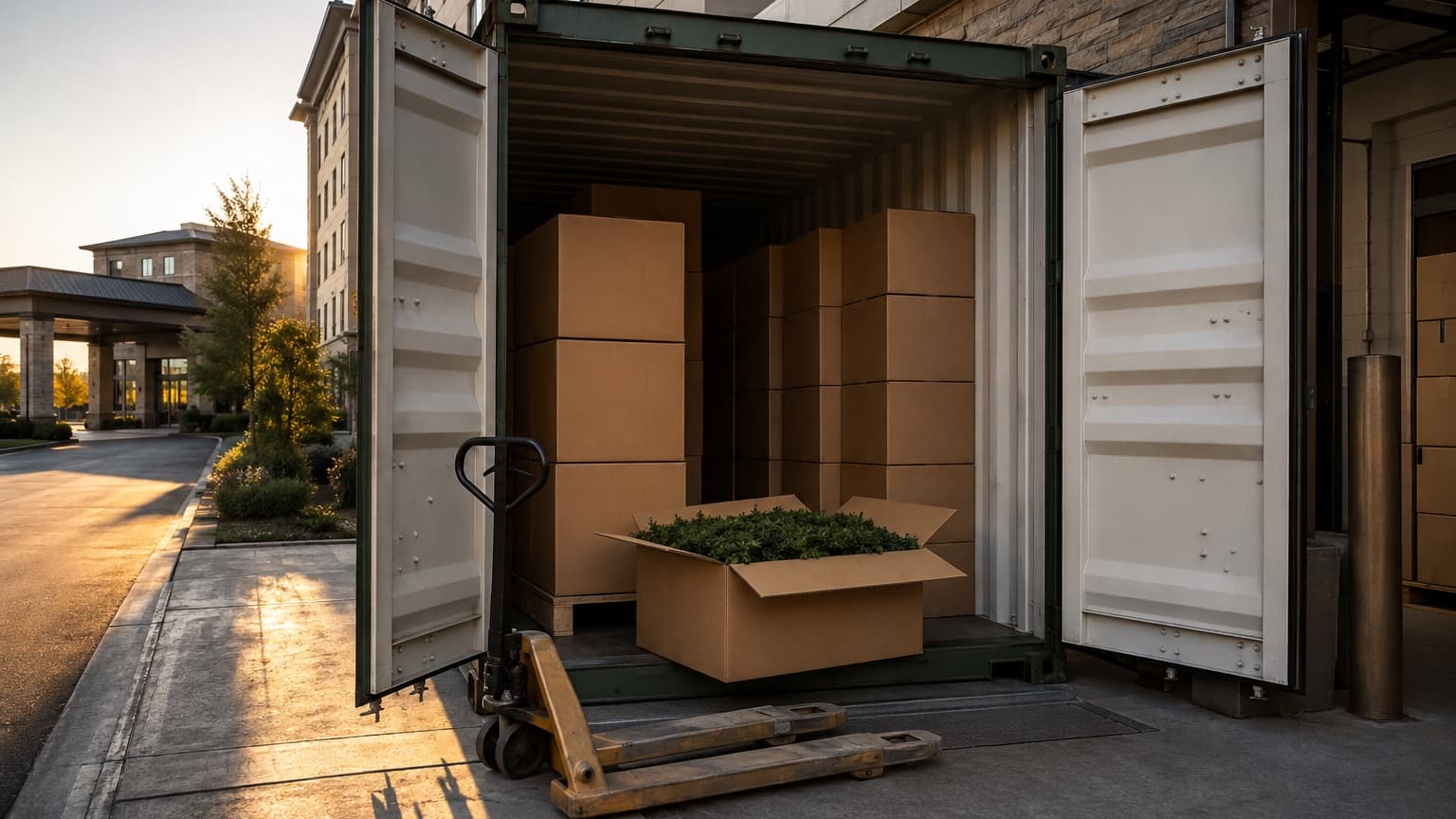
A hospitality group with eleven openings over eighteen months does not have a greenery order. It has eleven of them, each landing on a site that will not be ready on the date the contract says. The purchase order is the wrong unit for that job. The container is the right one.
This is how we run a phased supply, stage by stage, and what we need from the fitter at each point to keep it on schedule.
1. Specification: the brief becomes a SKU list
The brief we need is not a mood board. It is a list of zones, each with a ceiling height, a light condition, a code requirement and a target install date. From that a specifier matches SKUs: a 2.75 m banana tree for a double-height lobby, 232 cm pothos for a mezzanine rail, a 213 cm maple for the restaurant entrance. Every line carries a product ID, and that ID is the reference that survives all the way to the fire marshal's clipboard.
Two decisions get made here that are hard to unpick later. Which components need the Fire Retardant + UV Resistant option (anything within sight of glazing, or under a code that names artificial planting). And the split between sites, because that sets how many containers you need and in what order.
2. Production lock: MOQ and windows against a named facility
Once the SKU list is agreed we lock it against one manufacturing facility in our network, with a minimum order quantity and a delivery window per phase. Locked means the moulds are scheduled and the polymer is allocated. It does not mean the whole order ships at once.
For the eleven-site example, a typical structure is four quarterly releases, each covering two or three openings. We pad the first release by roughly 15 percent on the smaller items to absorb breakage and scope creep on site. That padding costs almost nothing in the container. As an air-freight top-up it costs a fortune.
Lot numbers are assigned at this stage. Every piece is laser-engraved with one, and each lot maps to the batch that went through UL 94 testing. Keep the lot list with the submittal. The inspector will ask.
3. Container load: packed for install day, not for the warehouse
A 40' high-cube holds more foliage than most people expect, provided it is packed by someone who knows what a fitter does on day one. We build each container to a project manifest and tag every carton with a zone identifier taken from the fitter's own drawings. Lobby A. Mezzanine B. Terrace C.
The container can then be unloaded straight to the zones with no sorting stage in between. On the jobs where we have measured it, that removes 30 to 45 percent of on-site labour compared with a palletised delivery that has to be broken down and re-sorted in a car park.
A partial 20' load is available when a phase is small. It costs more per piece, so we would rather move a small opening into the neighbouring release than run a half-empty box.
4. Port to site
US shipments clear at the port and travel inland by road, either to a staging facility or straight to site. European projects are drop-shipped to a staging point near the first opening in the release. Either way the fitter receives the manifest, the zone map and the lot list before the container arrives, so the receiving crew knows what is in every carton before it is opened.
What slips, and what we do about it
Dates move. A site due in March opens in May, and the container was built for March. Hold the release at the port or the staging facility rather than pulling it forward. Storing a sealed container is cheap next to re-sorting an open one.
A brand standard changes mid-rollout, and the atrium tree in release two now has to match a new flagship. Because the SKU list and the moulds are locked per release, we swap the tree in releases three and four without touching what is already packed.
A fire marshal asks for reports on a specimen that was not in the first submittal. This is the one that stalls openings. Quote product IDs on every submittal and keep the lot list current, and there is nothing to chase.
What we need from you to quote
Volume by site, the opening schedule with the confidence you have in each date, and the sectors involved. From that we return a container manifest and a lead-time proposal within one business day. The proposal is expressed in containers and releases, not units. If the number of containers surprises you, have that conversation before production lock, not after.