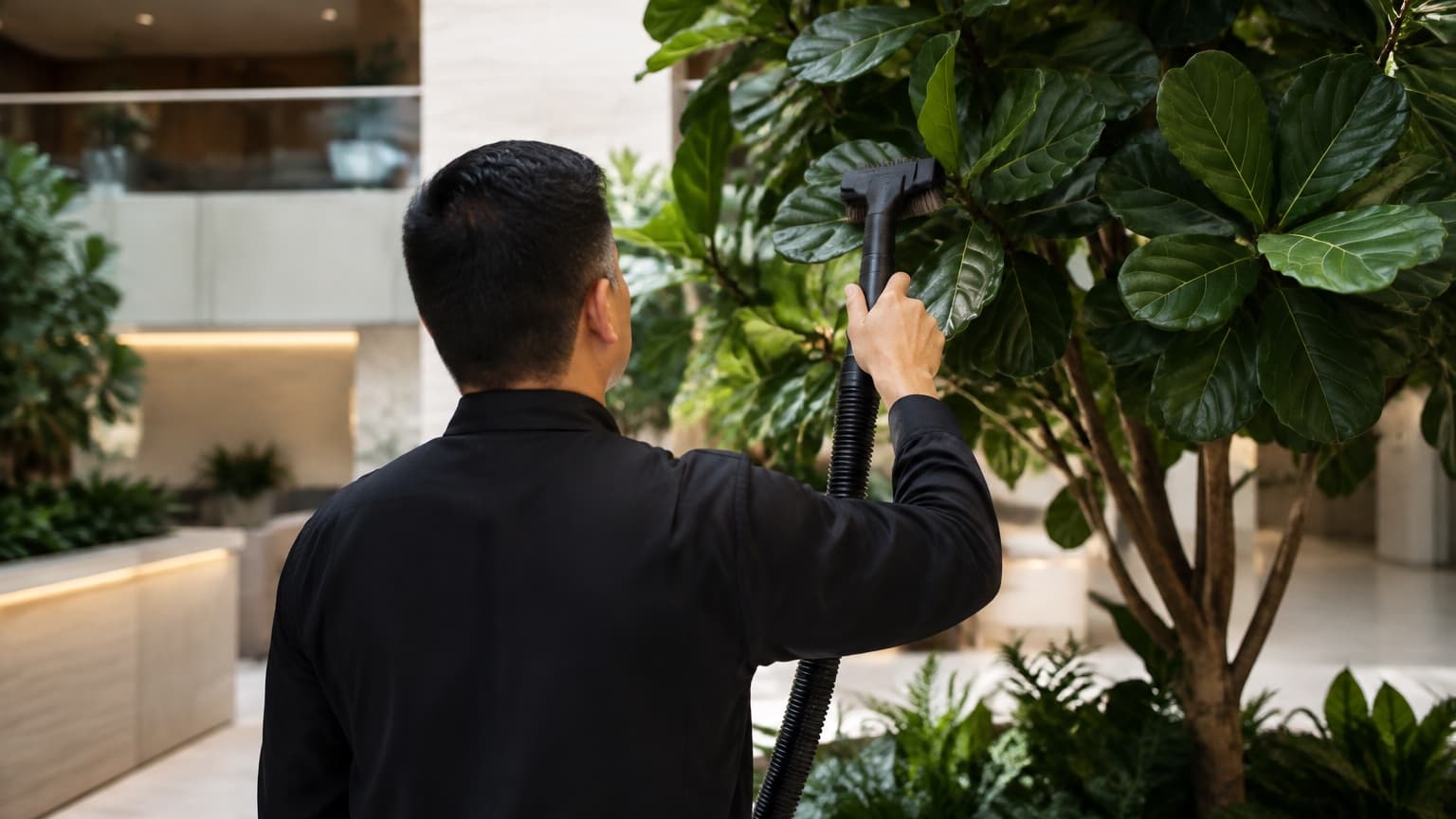
"Zero maintenance" is the line every artificial planting supplier uses, including us. It is true about the things live planting needs and untrue about the things a building needs. This is the itemised version, written for the facilities manager who inherits the installation after the fitter has gone.
What goes away
Watering, and with it the irrigation lines, the drip trays and the water damage under planters. Pruning, and the contractor who did it. Seasonal replacement of specimens that did not survive the air conditioning. Pest control for the planters. The soil, and the fungus gnats that arrive with it. For a corporate atrium with forty large specimens that is typically a maintenance contract plus a few thousand a year in replacements, and it stops on install day.
What stays: dust
Dust is the whole maintenance job. A leaf that is never cleaned collects a grey film in three to six months in a lobby with street doors, longer in a sealed office. The film does no harm to the material. It does make a 2 m tree look like a prop.
A schedule that works for most commercial interiors:
| Zone | Method | Interval |
|---|---|---|
| Lobby, retail frontage, anywhere near street doors | Vacuum with a soft brush attachment, top to bottom | Monthly |
| Atria, mezzanines, open-plan floors | Same | Quarterly |
| Deep interior, low traffic | Same, or a duster where access is awkward | Twice a year |
| Green walls | Soft brush vacuum on the top third, leaf blower on low for the rest, working downward | Quarterly |
Skip anything sold as leaf shine. It leaves a film of its own, which then holds more dust. Water and a microfibre cloth is enough when vacuuming is not.
Because our fire retardant and UV inhibitors are compounded into the polymer, none of this cleaning touches the rating. That is the practical difference from a sprayed product, where every wipe-down removes some of the treatment and the certificate quietly expires between inspections.
What stays: contact damage
Tall specimens on a retail floor get leaned on, grabbed by children and clipped by trolleys. LDPE at 2.8 to 4.1 mm wall thickness bends and recovers. It does not snap the way thinner PE or silk foliage does. Damage, when it happens, is usually a stem pulled from its socket, and it goes back in by hand.
A leaf that is torn off is the one that needs replacing. Which brings us to the job that is new.
The new job: matching a replacement
Every piece we ship carries a laser-engraved lot number. The lot maps to a production batch, the batch to a set of UL 94 test reports, and a fire marshal can ask for that chain at any inspection. When a facilities team replaces a torn branch with one bought from a general supplier, the chain is broken for that specimen and the inspector is entitled to fail it.
So the maintenance file for an artificial installation needs two things a live installation never did: the lot list from the original submittal, and a stock of attic spares from the same lot. We suggest 5 percent of the smaller items and one full spare of any specimen tree, packed in the original container. It sounds like a lot until the first replacement is needed two years on and the batch has long since been superseded.
A one-page handover
What the fitter should leave with the building:
- The lot list, by zone, with product IDs.
- The UL 94 and ISO 105-A02 reports for each lot.
- The cleaning schedule above, marked up for the actual zones.
- The spares inventory and where it is stored.
- The specifier's direct line for replacements.
Five items on one page. It is the difference between an installation that passes its year-three inspection and one that generates a very awkward email.