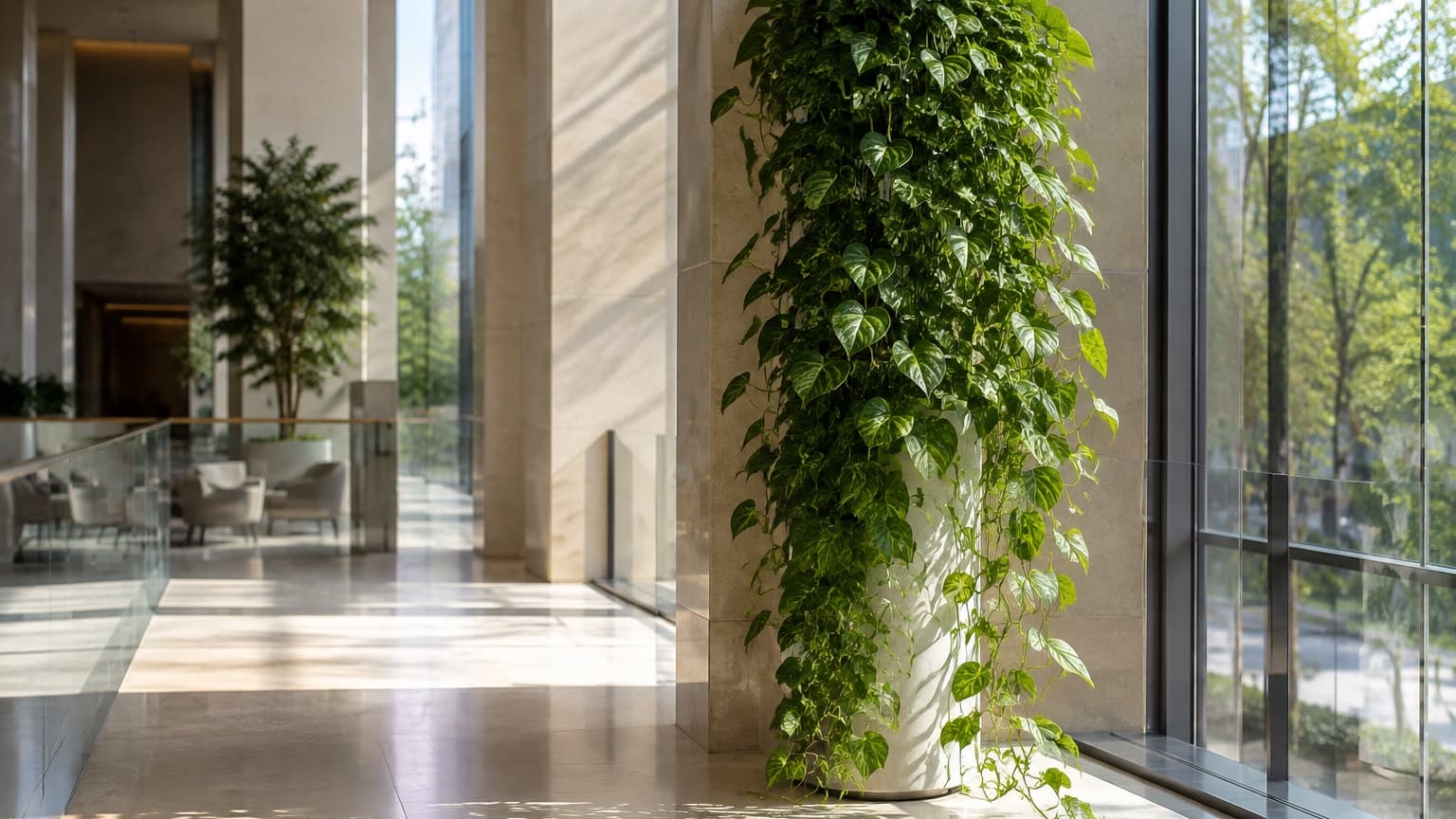
Every artificial plant catalogue says UV resistant somewhere. Almost none of them say what the test was, how long the protection lasts, or which light it was measured under. This is our attempt to write those three things down for our own range, limits included.
Fading is a chemistry problem before it is a colour problem
Polyethylene does not fade the way a printed poster does. Ultraviolet light breaks the polymer chains. The visible symptoms arrive in order: a chalky surface, a colour shift toward yellow or grey, and finally brittle edges that crack when a cleaner brushes past. The colour change is the early warning. The brittleness is the failure.
UV inhibitors slow the chain breaking. They can be sprayed on afterwards, in which case they sit on the surface and go wherever the surface goes: onto cleaning cloths, into the dust, off with humidity. Or they can be compounded into the LDPE at the injection stage, distributed through the full wall thickness of the leaf, which in our specimens is 2.8 to 4.1 mm. We do the second. A sprayed inhibitor is a finish. A compounded one is a property of the material.
How ISO 105-A02 grades it
ISO 105-A02 is a grey scale, borrowed from textiles, for assessing colour change after exposure. A sample is compared against a reference under controlled light and given a grade from 5 (no perceptible change) down to 1 (severe change). It records what happened to the colour. It makes no promise about the future. Its value is that two products tested to the same exposure can be compared without anyone's marketing getting in the way.
Our foliage is tested to ISO 105-A02:1993 with corrigendum 2 of 2005, by SGS. That result is what we guarantee against: three years of indoor commercial use with no perceptible colour change. Ask for the report and the grade on the specific SKU. A supplier who quotes the standard without the grade has quoted a test method, not a result.
Where the guarantee stops
Indoors, under glazing or artificial light, the only variable that matters much is UV dose. Outdoors there are three more: moisture, oxygen and temperature swing. Each accelerates the breakdown on its own, and together they do more than the sum. A terrace in Phoenix and a terrace in Dublin age the same leaf at very different rates, and the Dublin leaf may go first because it spends more of the year wet.
So the guarantee is for indoor use. That is the condition under which the test result transfers to the installation, and we would rather state it than let a fitter discover it on a terrace in year two. Outdoor installs are still done with our UV option, and most of them do well. We ask for the site conditions before we put a number on the lifespan.
Where the UV option earns its cost indoors, in rough order of exposure:
- Anything within a few metres of south-facing or west-facing glazing.
- Atria with rooflights, which deliver UV from above onto the top surface of every leaf.
- Lobbies with curtain walls, where exposure runs all day rather than a few hours.
- Retail frontage and window displays.
Deep interior zones with no daylight can take the standard product. There is no reason to pay for inhibitors the light will never reach.
Trailing foliage takes the worst of it
Wall-mounted and trailing pieces present a lot of leaf area to a window at a shallow angle, and nobody rotates them. On a green wall the top third does most of the ageing. If a wall is going near glazing, we specify the UV option for the whole wall or, on a tight budget, for the panels above the sightline where fading shows first.
The short version for a spec clause
UV inhibitors compounded into the polymer, not applied. Colour fastness to ISO 105-A02, third-party report per SKU with the grade stated. Indoor guarantee of three years. Outdoor use by agreement, with site conditions on record. Four sentences, and a spray cannot meet any of them.